
This project resulted in the design and construction of an interactive wave energy demonstration tank. The equipment shows the importance of control in the efficient conversion of wave energy, while highlighting the benefits of renewable sources of energy to diverse audiences, including the non-technical public and other technical disciplines.
Activity Organizer
John Ringwood (Director, Centre for Ocean Energy Research, Maynooth University, Ireland)
IFAC Sponsor: Ireland NMO
Description
Supervised by Centre for Ocean Energy Research at Maynooth University director Prof. John Ringwood, a mechanical engineering master’s student was recruited to design and construct an interactive wave energy demonstration tank to show the importance of control in the efficient conversion of wave energy, while highlighting the benefits of renewable sources of energy to diverse audiences, including non-technical public and other technical disciplines.
The interactive rig can be operated by the ‘audience’ – in particular to ‘tune’ the energy maximizing controller. The system includes a new purpose-built demonstration tank with wavemaker and beach (for wave cancellation), a small-scale wave energy converter (WEC) and an electronic control system to optimize the WEC motion for power capture.
The audience will see a power output display, showing the effect of various control tunings. The rig will demonstrate, more than the accompanying presentations and posters, the potential for wave power and the necessity, within wave systems, of control to maximise power output. The rig, accompanied by videos, presentations, and posters, will be used for public engagement and dissemination activities. The demonstration system will also be used at national (and where practical, international) conferences, such as the Irish Signals and Systems Conference to demonstrate the potential, and importance of control in making wave (and renewable energy, in general) economic. The intern will gain substantial knowledge and experience of control from a wave energy perspective – potentially leading to further studies in control and creating a future member of the control community.
There is clear scientific consensus that we need to transform our energy systems to reduce Green House Gas emissions and play our part in limiting global warming to a 1.5°C increase. Ireland’s climate action plan includes an increase in renewables to 70% of our energy needs by 2030. Climate change is cited among young people as one of their most pressing concerns[1]. Wave energy has the potential to service nearly twice Ireland’s peak energy demands [2]. Moreover, control technology can double the energy taken from Wave Energy Converters (WECs)[3], making wave energy an ideal platform to demonstrate the necessity for control. The project combines a subject of significant interest to young people and that is of international importance, aligned with an area that can clearly demonstrate the necessity of control.
[1] Youth Climate Justice Survey 2020, Spunout.
[2] Offshore Renewable Energy Plan, Govt. of Ireland
[3] Ringwood, J.V., Bacelli, G. and Fusco, F. Energy maximising control of wave energy converters, IEEE Control Systems Magazine, Vol.34, No.5, Oct. 2014, pp 30-55. [PDF]
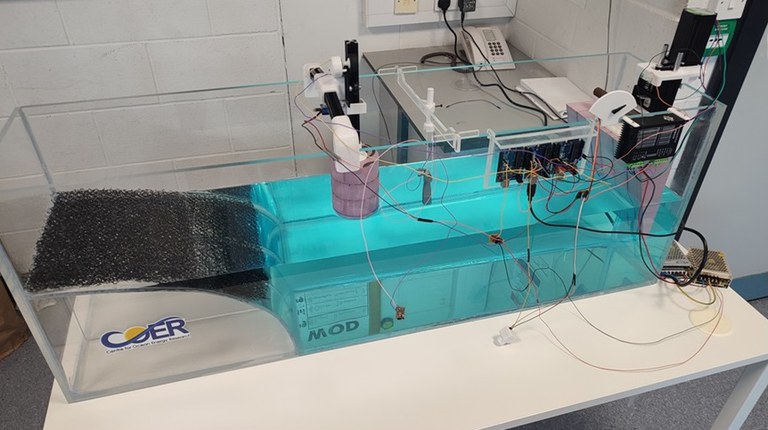
Side view of tank, wave energy device (purple) and control electronics
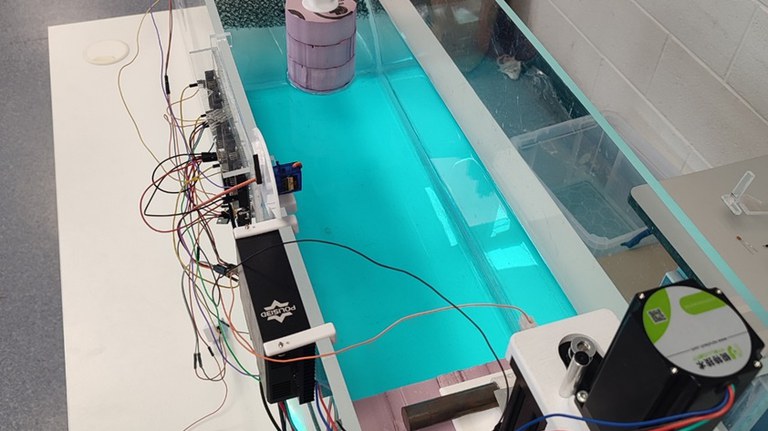
Plan view of tank, from wavemaker end
