
Introduction
The main contribution of this project consists of developing a series of short 2D hand-drawn animated cartoons on control. The main target of the proposed videos is undergraduate students who take a control course for the first time. However, some videos address general notions on control (e.g., feedback) and its applications, and are, therefore, dedicated for outreach activities. The videos are available on the IFAC YouTube channel in a dedicated playlist https://tinyurl.com/IFACoosCaR.
Project Details
Project Lead: Prof. Cristina Stoica, CentraleSupélec/L2S (Univ. Paris-Saclay), France, [email protected]
IFAC Sponsors: TC 9.4 Control Education and IFAC Education Activities Committee
Project Goal and Outcomes
The main goal of the project was to create a series of 2D hand-drawn animated cartoons on control to:
- Motivate engineering students who are taken a first control class to pursue the “Control Engineering” specialization, and later on with a control engineering career;
- Disseminate basic control notions (e.g., feedback) to the general public, combining elements from Art and Engineering in order to arouse children’s interest in Science, Technology, Engineering, and Mathematics (STEM).
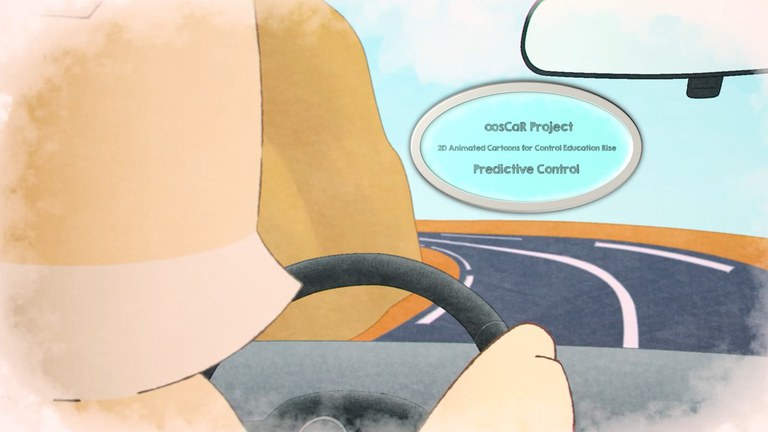
Eight short videos were created. Each video illustrates only one main concept on control, without technical details (e.g., highlighting the importance of predictive control without presenting equations). The following concepts have been illustrated: feedback, system modeling, PID control, predictive control, state estimation, nonlinear control, learning-based control and cooperative control.
Activities and Video Development
The animated cartoons videos development considers the following elements:
- Storytelling approach. Each video presents a scientific concept illustrated by an everyday situation, together with an easy-to-understand industrial concept.
- Accessibility and inclusivity aspects. The videos are available online, with the possibility to adjust the playback speed. Transcripts and subtitles are possible via YouTube.
- Two-part structure. Each video is designed in two parts: first, it presents the main control notion, while, second, an industrial or everyday application of the considered notion is analyzed.
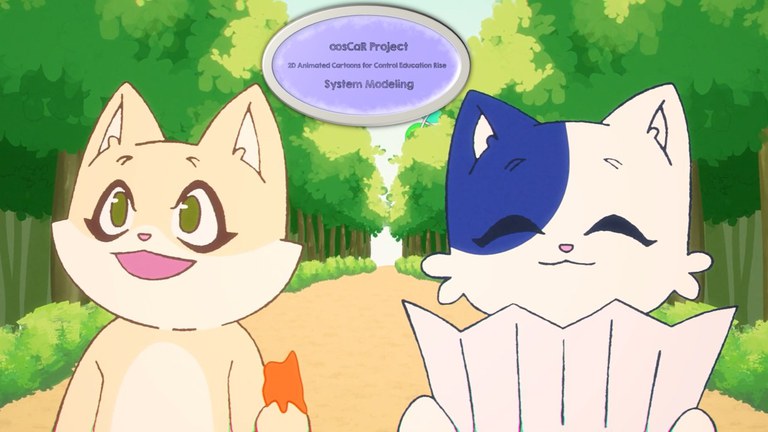
In the early stage of the project, one of the key questions was related to the characters’ design of the animation. There were several constraints in choosing the characters. The project members wanted to keep neutral, inclusive, common, well-known, somehow funny, easy to draw characters. In order to facilitate the animation, only two characters were considered within the perspective of conversation-based scenarios. With all these constraints, the project members decided that proposing two cats could be a suitable solution, in order to avoid gender stereotypes. Each video is constructed on a learner-teacher scenario, with the possibility to switch roles between cats from one video to another (e.g., the two characters could be seen as teammates).
The main steps for the video development are:
- Before starting a script. The videos developed during this project have a pedagogical goal. Therefore, before starting to write the script, it is important to define the message of the video (e.g., the main points for the students to see, the main source to motivate them to watch this video, such as points to hit and take-aways).
- Writing the script. During the script writing phase, the author of the script considers several aspects: as the scientific content (both in terms of theoretical concept and examples of practical applications), the scenario (i.e., the context of the discussion between the two characters), etc. In addition, the script author provides detailed indications for the voice recording (e.g., words to be emphasized) and the storyboard (e.g., graphics to be added on background to better illustrate the considered scientific concept).
- Creating a storyboard. Several ideas are indicated for the storyboard; however, this step involves a lot of creativity from the 2D animator and therefore is one major part of the artistic development of this project.
- Voice recording. The two project members involved in this step have tremendous experience in video recording or theater performance, and they offer a new artistic perspective by adding their voice signature.
- Creating an animation. This part mostly benefits from the creativity of the 2D animator, leading to the cumulus of artistic and scientific developments.
- Iterative feedback. In addition, at each step there are iterations with other members of the project resulting in an improved final version of the animated videos.
Participants and Project Team
This project was developed by an international team composed of (in alphabetical order):
- Louis Bayle de Jessé
- Andrei Braitor
- Pedro Castillo
- Brian Douglas
- José Luis Guzman
- Julie McDonald
- Steffi Knorn
- John Anthony Rossiter
- Cristina Stoica (project lead)
- Damiano Varagnolo
- Antonello Venturino
- Antonio Visioli
- Miléna Ung
Five undergraduate students from CentraleSupélec also joined the project (in alphabetical order):
- Antoine Ducournau
- Eden Elbaz
- Lina Etcheverry
- Thomas Ferrer
- Leïla Lallemand
Results and Good Practice
One of the most significant takeaways is the effectiveness of storytelling in simplifying complex concepts while maintaining student engagement. By linking theoretical notions to real-world applications, students found the material more relatable and easier to grasp. However, achieving the right balance between educational depth and accessibility proved challenging. Ensuring technical accuracy while avoiding unnecessary complexity required an iterative feedback process involving both control researchers/educators and 2D animators to refine content and maintain clarity.
Another critical lesson concerns the interdisciplinary collaboration required for such a project. The involvement of control researchers/educators, animators, and voice actors necessitated a structured workflow for scriptwriting, storyboard design, and animation production. Budget and time constraints underscored the importance of streamlined procedures and effective communication among team members.
Character design and voice acting emerged as essential factors in enhancing engagement and learning outcomes. The decision to use two neutral cat characters allowed for a relatable yet non-distracting presentation of control concepts. Viewer feedback highlighted the importance of voice modulation, pacing, and dialogue style in maintaining attention and reinforcing key ideas. Additionally, accessibility considerations — such as subtitles and transcript availability — proved crucial in ensuring inclusivity, allowing a more diverse audience to benefit from the content. These findings suggest that future Control Education initiatives could further explore the role of visual and auditory elements in optimising student comprehension and motivation.
Future Activities or Next Steps
The ∞sCaR project was initially planned in two phases:
- Phase 1: development of hand-drawn animated cartoons on control;
- Phase 2: development of quizzes related to each cartoon.
Finally, in order to produce high-quality animated control cartoons, additional time was needed and therefore only the first phase was implemented. Proposing interactive quizzes for these videos is part of future developments. Future work also considers the translation of the videos into several languages which will simplify comprehension and will facilitate worldwide spreading the results. Future work also consists of advertising the videos (already available on the IFAC YouTube channel in a dedicated playlist https://tinyurl.com/IFACoosCaR) during several major control events (e.g., IFAC World Congress 2026) and on social media.
Publications
[1] C. Stoica, A. Visioli, J.L. Guzman, J.A. Rossiter, B. Douglas, A.-C. Braitor, A. Venturino, D. Varagnolo, J. McDonald, P. Castillo, S. Knorn, M. Ung, “Hand-drawn animated cartoons for Control Education: insights from the oosCaR Project”, 14th IFAC Symposium on Advances in Control Education, pp. 167-172, Budapest, Hungary, June 17-21, 2025.
[2] C. Stoica, A. Visioli, J.A. Rossiter, J.L. Guzman, B. Douglas, A. Venturino, A.-C. Braitor, D. Varagnolo, J. McDonald, P. Castillo, S. Knorn, M. Ung, “Art and Control Engineering: developing animated cartoons for Control Education”, joint 9th IFAC Symposium on System Structure and Control (SSSC), 19th IFAC Workshop on Time Delay Systems (TDS), and 2nd IFAC Workshop on Control of Complex Systems (COSY), invited session “Where Art and Science meet”, Gif-sur-Yvette, France, June 30-July 2, 2025.
[3] T. Ferrer, L. Lallemand, L. Etcheverry, E. Elbaz, A. Ducournau, C. Stoica, J. Anthony Rossiter, A. Visioli, J. Luis Guzman, B. Douglas, J. McDonald, M. Ung, L. Bayle de Jessé, “Art and Control Engineering: Developing a 2D Animated Cartoon on System Modeling for Students by Students”, submitted to the IFAC World Congress 2026, Open Invited Track “Beyond Art & Control & Engineering”, Busan, South Korea, August 23-26, 2026.
