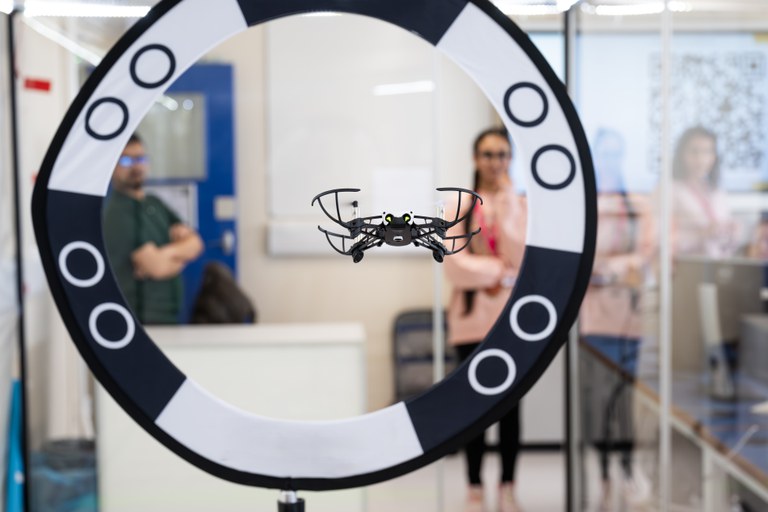
This project aimed to design a series of activities to engage a diverse range of young people in hands-on learning with a focus on mathematics, physics, and programming of drones in a controlled lab environment. The target audience for the workshop was GCSE (age:14-16 years) and A-level (Age:16-18 years) students. The intent was to give them an opportunity to explore and experience field of engineering by writing programs to operate small aerial drones. Additionally, drone flight demonstrations were conducted on Open Days to engage the broader public with applications of engineering science.
Activity Organizer:
Junaid Ahmed Memon, Department of Engineering Science, University of Oxford, U.K.; [email protected]
IFAC Sponsor: TC 9.4
Description:
The goal of the workshops and activities was to help participants achieve the following learning outcomes:
- Programming Skills: Write programs that control drone movement by following fundamental programming structures like variables and loops.
- Engineering Design Skills: Understand the design-build-test procedure involved in designing a project, from initial concept to the outcome.
- Problem-Solving Skills: Develop critical thinking and troubleshooting skills through the process of debugging programs.
- Teamwork: Working and collaborating in teams to achieve a common goal.
Current Context:
The Department of Engineering Science has two established outreach programs: Uncover Engineering and UNIQ. UNIQ serves as the University of Oxford’s access program, catering to state school students in Year 12 (or equivalent). This program prioritizes admission for students with strong academic records, particularly those hailing from underrepresented backgrounds at Oxford and other universities. Meanwhile, Uncover Engineering promotes Engineering Science to students from underrepresented backgrounds in higher education, with a focus on girls and students of Black African and Caribbean heritage, aged 14-15 (year 10) or 15-16 (year 11). Priority admission to these programs is granted to students facing socio-economic disadvantages. Both these outreach programs are well established and are fully subscribed to each year. There is funding already secured for their accommodation and travel to the University.
As part of these residential programs, students attend workshops in the Department of Engineering Science. These workshops take place in teaching labs and focus on a range of disciplines from mechanics and electronics to 3D design. While our team has experience of running these workshops, currently, none of these workshops have a Control Engineering theme and focus. The drone workshops that we designed with the support from IFAC and Department of Engineering Science played a vital role in adding a new outreach activity – providing opportunity to participants to explore how mathematics, physics and programming is related to controlling drones in air to draw shapes.
Project Components:
The project involved designing a series of activities in the form of a workshop involving mini drones to introduce participants to engineering and programming. This involved developing a 30-min talk to introduce fundamentals of flight and a handout which guided participants through the steps required to create drone programs. The talk was a short but comprehensive kick-off presentation delivered by one of project team members, to ensure all students have the knowledge and safety instructions needed to complete the activities.
After the talk, participants went through the handouts and asked for help from demonstrators–e.g., if anything was not clear from the handout. Demonstrators were post-graduate students and staff who were supervised by the project team. On average we had one demonstrator per group of 3 students.
The theme of the workshop was to draw shapes in the air by programming drones to follow a sequence of commands. Therefore, handout guided the participants detailed instructions. Firstly, it introduces Design, Build and Test cycle of engineering and then guides them through the set of activities, worksheets, and exercises. For activities, participants are given basic design of code to learn the syntax and programming constructs. Worksheets helped them structure their thoughts and collect data. Whereas exercises set the goals for them to design the code themselves. Each activity, workshop and exercise were tried and tested and aimed to introduce key learning outcome.
Execution:
We organized the trial run of workshop with our first-year students of Engineering Science in the university and got some feedback to adjust the explanations, length, and nature of activities. Their feedback was very useful in structuring activities in the form of worksheets embedded in notes so that participants can design program on worksheets and then translate the designs into a program. We realized very quickly from this experience that text-based programming language might not work for 14–16-year age group students therefore we transformed activities into block-based coding environment like scratch while maintaining text-based coding environment for 16–18-year age groups.
After the trial, we updated the handouts and activities and run the activities for the group of 14–16-year visitors. The visitors were all female students who participated in Cyber girls’ competition (CyberFirst Girls Competition – NCSC.GOV.UK) and were hosted at the department on their Oxford visit. This helped us to offer the workshop to our actual audience level. After successful run with Cyber Girls visitors, we offered workshops to our target outreach program participants (i.e. Uncover and UNIQ). Following table shows logistic details of drone workshop activities run in year 2024.
| Session For | Session Date(s) | Duration (min) | # of Sessions | Participants per session | Total Participants |
| Cyber Girls Visitors(Age Group:14-16 years) | 2nd March | 75 | 2 | 12 | 96 |
| Uncover(Age Group:14-16 years) | 3rd– 4th April | 180 | 3 | 12 | |
| UNIQ(Age Group:16-18 years) | 15th – 16th July | 180 | 3 | 12 |
Feedback from students:
At the end of the workshop, we asked for feedback from participants on the length of workshop and satisfaction on achieving learning outcomes. About two-thirds of the students indicated that the workshop was “the perfect length”; the significant majority of the remainder would have preferred a longer workshop. About two-thirds were also “Very Satisfied” with the learning outcomes, about one-third “Satisfied,” and one “Neutral.”
The feedback form also included open-ended questions to gather verbal feedback. Below are some of the positive responses we received:
- “I learned more about coding, robotics, and how drones work. I especially enjoyed programming the drones to perform fun tricks.”
- “I gained valuable teamwork skills and learned how to successfully program a drone.”
- “I learned a lot about forces and velocity in relation to drones, which greatly improved my logical thinking skills. I really enjoyed the coding, and the instructor was incredibly enthusiastic, explaining concepts in multiple ways to ensure understanding.”
A common critical comment from participants was the desire for more time and additional activities to further enhance their learning experience.
Outreach communication after the workshops:
The following link covers the advertisement of Uncover event which include drones’ activity beside other activities.