
Activities Activity Fund
2 min read

Control Conference Africa (CCA) 2021 – Sponsorship of deserving academics and graduate students from Africa

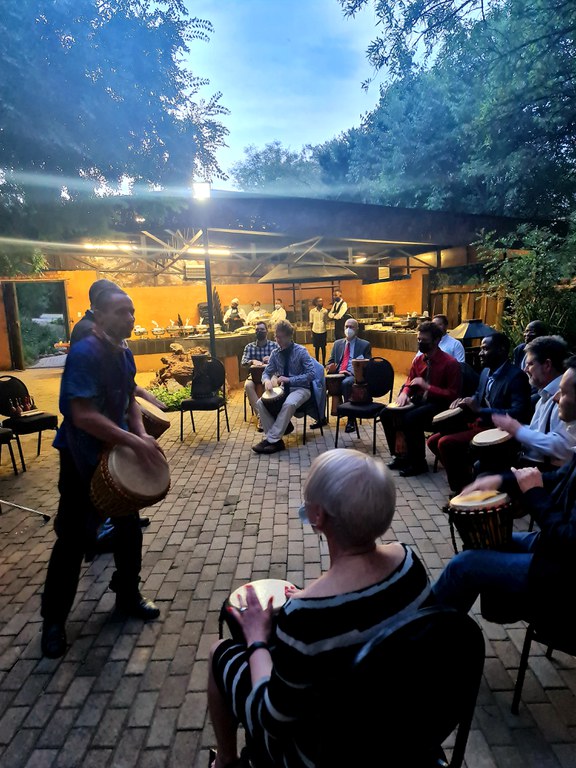
The Control Conference Africa (CCA) 2021 was held on December 7–8 in Muldersdrift, South Africa, and delivered in a hybrid format due to the onset of the Omicron variant. Supported by the IFAC Activity Fund, the event provided six sponsorships for African academics and graduate students, with SACAC waiving their registration fees. To ensure smooth technical delivery while retaining live Q&A sessions, all virtual presentations were pre-recorded and broadcast to attendees.

Contact: Dr Kevin Brooks, University of the Witwatersrand, [email protected] Sponsoring IFAC Body: South African Council for Automation and Control (SACAC)

As proposed in section 5 of the initial application, the Control Conference Africa 2021  (CCA2021) took place on the 7th and 8th of December in Muldersdrift, South Africa and virtually all around the world.  Professor Eric Kerrigan served as IPC  chair and the co-chair was  Dr Derik le Roux.  The editor was Dr Murray Bwalya, and the IPC Vice-chair for industry was Dr Loujtie Coetzee from Mintek.  The NOC was chaired by Dr Kevin Brooks, ably assisted by co-chairs Professor Sayed Hassen and Professor Steven Bradshaw of Stellenbosch University. The Vice-chair from Industry was Dr Laurentz Olivier, Dr Lidia Auret and Mr Anshu Murdan managed communications and hybrid arrangements.

The kind support from the IFAC Activity Fund allowed the organisers to offer six sponsorships, three to academics and three to students.  Eight applications were received and the sponsorships were awarded to the six authors whose papers were accepted on the recommendation of the associate editors.  SACAC waived the registration fees for these authors.  One condition of the sponsorship was that the author should present their paper in person.

The total registration for the conference was 49 people, with 33 being for physical attendance and 16 virtual attendees.  With exquisitely bad timing the Omicron variant was first reported in South Africa on the 24th of November.  The organisers had no choice but to allow delegates to modify their registration from physical to virtual.  Unfortunately, 5 of the 6 sponsorship recipients chose to do so.

The organisers had put plans in place for this situation and, using a popular modern term, pivoted their efforts into ensuring that the best possible hybrid event was delivered. All authors and plenary speakers had been requested to provide a video of their presentation, and the decision was made that all virtual presentations would consist of a broadcast of the recording, to avoid any bandwidth issues.  Despite this, authors were encouraged to be at the session in which their paper was presented, and all Q&A was conducted in person.  In this way, the conference retained the aspect of “confer” which is a vital part of such an event.
← Back to Activities

Related from Activity Fund

Teaching Analytics: a feedback control approach to aid student self-assessment in higher education.

The project Teaching Analytics: a feedback control approach to aid student self-assessment in higher education focuses on developing an open web platform to help teachers share assessment materials globally. Teachers can upload, categorize, and search for exam questions in standard LaTeX format. Students can answer these questions online to track their learning progress through personalized concept maps.


Activities 25-Aug-2026

Zoom Workshop Series on Control Systems and Data Science towards Industry 4.0

This workshop series highlights the integration of control systems theory, data science, and machine learning to advance Industry 4.0 applications. Organized by S. Joe Qin from the City University of Hong Kong, the three-module online event brought together global experts and industry leaders. It covered key topics including predictive analytics, process automation in chemical and biological engineering, and machine learning for electrical systems.


Activities 25-Aug-2026

Pocket-Sized Portable Labs: Control Engineering Practice Made Easy

Pocket-Sized Portable Labs: Control Engineering Practice Made Easy demonstrates how simple experiments using compact, microcontroller-based kits like Arduino and Raspberry Pi can inspire students to study control engineering. Organized under the Portuguese Association for Automatic Control and led by Paulo Moura Oliveira, the project utilized the Temperature Control Laboratory (TCLab) kit to bring hands-on learning into classrooms and homes during the COVID-19 pandemic.


Activities 25-Aug-2026

CTRL+ESC: Control Theory Escape Room Development at TU Berlin

To help introduce control engineering and its underlying principles to the general public, this project created a fun, engaging and accessible way of learning about and being exposed to control engineering by developing a suitable “escape room” for the general public, which consists of a set of puzzles, located in a room (or a collection of rooms), in which participants enter and must solve the puzzles in order to leave the room or get to the next room.


Activities 25-Aug-2026