
This activity collected material of female historical control influencers. The project members interviewed several women with long careers in control engineering and collected material from different sources. The material was then consolidated. A professional editor and communication specialists wrote a text based on the material and engaged an illustrator to develop images combining portraits with technical drawings. The result of 4 portraits are now publically available on a homepage. The material can be downloaded and included in the classroom as well as used as an online resource. In addition, the material was presented at the IFAC 2023 World Congress.
Contact: Prof. Charlotta Johnsson, Dept of Automatic Control, Lund University, Sweden, [email protected]
A role model is a person who serves as an example by influencing others, and inspiring others to imitate his or her behavior. When we are young and grow up, the role model is usually an elder person, someone who we admire. Often it is a parent, a teacher, a sibling or an elder friend who is that person that we look up to and, intentionally or unintentionally, get inspiration from. As we grow older, and start to shape our working-life, it becomes important to have professional role models, people that we can identify ourselves with, people that demonstrate, in a good way, how our working life could be. Having them pushes us to make the most out of our working life.
It is interesting to look at the presence of role models in the control community. The elder professionals in this field, influences the younger, and thereby shape the younger generation.
There are many occasions where younger, potential future control professionals, could be influenced by elder professionals. One occasion is in the class room when examples of pioneers in the field are highlighted. Another example is in the everyday working environment (e.g., laboratories or offices), where histories and anecdotes from the past are shared. Yet another example are the award winners in the field, who just by getting the prize raise their influence in the field.
In the Department of Automatic Control, Lund University, Sweden (for example) only 11 out of the 128 Ph.D. theses, throughout its 60 years of history, are written by women. Statistics also show that only 14% of the PhD-students and 9% of the professors are of female gender. These numbers are very low. Most probably the statistics from control department in other corners of the world, are very similar. Could it be that female role models are missing? It is noted that early pioneers that are highlighted in basic control courses often (always? ) are men–Bode, Nyquist, Kalman, etc. Also, award winners are to a very large degree men, for example the Richard E Bellman Award was given to a man 40 years in a row. This has an explanation in the fact that there are few women in the field, but how could they enter if there are hardly any role models to identify with?
The intention in this project is to find out if there are some early female historical influencers? We believe that the best way to find out would be to identify a set of elder (retired or emeritus) female professionals, and by interviewing them get to know if they had any female role models? We also believe that the identified (retired or emeritus) female control professionals, act as role models in themselves. The interviews with the identified (retired of emeritus) female control professionals will serve as material for a portrait-series of historical female influencers. The portrait-series of these women could be used in various outreach material such as lecture notes and inspirational material for young and potential future control professionals. The interviews will also serve as input material to an academic paper to be submitted to a suitable control journal.
The primary purpose is to produce material that highlights historical female control pioneers (i.e., early role-models). The general thought is that everyone in the field will benefit from a more gender-equal field. The field cannot reach its full potential while a big portion of the potential contributors are not finding their way into the field. Therefore, the material will be of importance to the field in itself. However, the material will find an additional purpose amongst young, female, and promising potential candidates, who today have difficulty in finding anyone to identify with.

Eveline Gottzein
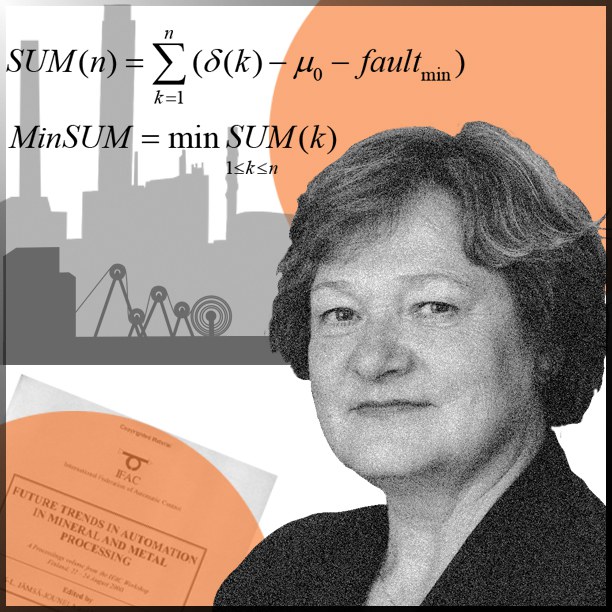
Sirkka-Liisa Jamsa-Jounela