
Introduction
The IFAC/SBA Seminar Series was a regional educational initiative organized by the Brazilian IFAC National Member Organization (SBA) to promote diversity and expand access to advanced control and automation topics in Brazil. By bringing recognized specialists directly to public universities in the Northeast, Center-West, and North regions, the activity provided hands-on training and networking opportunities to undergraduate and graduate students who historically face reduced access to face-to-face instruction compared to those in the South and Southeast.
Project Details
- Project Lead: Gustavo Artur de Andrade, Federal University of Santa Catarina, Brazil ([email protected])
- IFAC Sponsors: Sociedade Brasileira de Automática (Brazil NMO); TC 9.2; TC 9.4
Background and Objectives
The activity addressed a persistent geographical imbalance in access to advanced education and research opportunities in Control and Automation within Brazil. While students in the South and Southeast frequently access face-to-face training on current technical topics, students in the Center-West, North, and Northeast regions have fewer such opportunities. To bridge this gap, the seminar series combined advanced theoretical instruction, practical laboratory work, and academic networking hosted directly at partner public universities.
Programme and Activities
The series consisted of three two-day, in-person seminars delivered during the first semester of 2026:
| Regional Event | Host Institution & Dates | Lecturer | Topics & Scope | Attendance |
| First Seminar (Northeast Region) | UFRN (Natal) 23–24 March 2026 | Prof. Alexandre Sanfelice Bazanella (UFRGS) | Adaptive and Data-Driven Control: Linear-system identification, indirect data-based control, comparisons with model-based methods, Virtual Reference Feedback Tuning (VRFT), Optimal Controller Identification (OCI), and applications to UAVs, industrial processes, and power converters. | 15 students from Rio Grande do Norte, Alagoas, Ceará, and Bahia |
| Second Seminar (Center-West Region) | UFMT (Cuiabá) 21–22 May 2026 | Prof. Julio Elias Normey-Rico (UFSC) | Advanced Control Applications in the Energy Industry: Control and process optimization in the changing global energy matrix, featuring case studies on offshore oil production, solar-energy systems, and microgrids with renewable generation and hybrid storage. | 27 students from Mato Grosso and Goiás |
| Third Seminar (North Region) | UFAM (Manaus) 28–29 May 2026 | Prof. Tito Luis Maia Santos (UFBA) | Model Predictive Control (MPC): Fundamental MPC formulation, cost functions, prediction horizons, Generalized Predictive Control, Dynamic Matrix Control, state-space predictive control, constrained optimization, multivariable systems, stability, robustness, and introductory nonlinear MPC. | 29 students from Amazonas, Pará, and Roraima |
Organisation and Support
The series was promoted through official university channels and social media networks of the SBA and host institutions. Host universities provided classroom and laboratory facilities free of charge.
Funding from the IFAC Activity Fund and supplementary resources from the SBA supported the invited speakers and selected participants. Supported expenses included:
- Transportation, accommodation, and meals
- Course materials
- Full registration for all 71 participating students to attend the 2026 Brazilian Congress of Automatics (CBA 2026) in São Paulo in October 2026
Impact and Achievements
The approved objectives were fully realized without scope or audience reductions:
- Participation: A total of 71 students across multiple states gained high-quality technical instruction and practical experience.
- Community Engagement: Funding student attendance for CBA 2026 extends the project’s impact by integrating regional students directly into the national and international control communities.
- Academic Networks: Participant reports highlighted strong satisfaction with the practical activities and emphasized the value of establishing peer and specialist connections for future postgraduate studies and research collaborations.
- Schedule Efficiency: The North region seminar was advanced from August 2026 to May 2026, allowing the entire series to conclude successfully within the first semester of 2026.
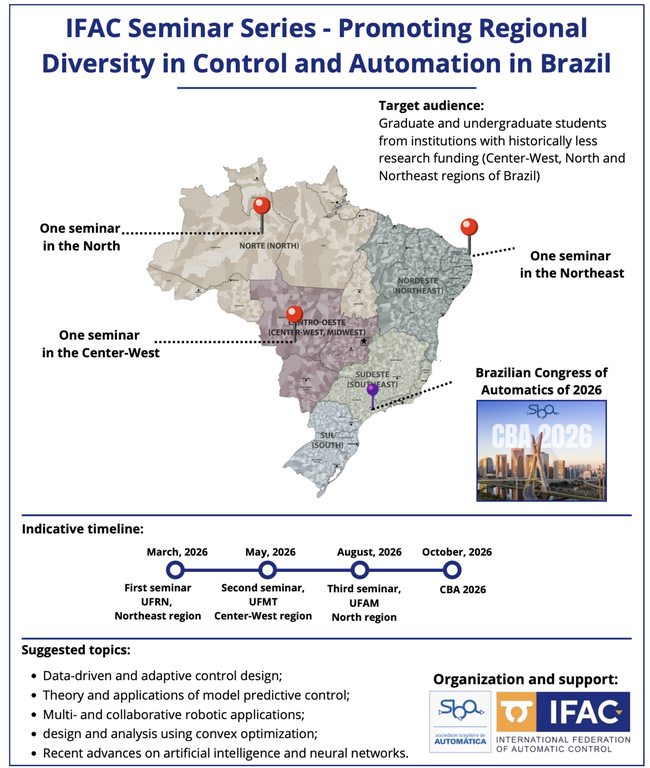
Figure 1: Infographic for the IFAC/SBA Seminar Series, illustrating the three regional seminars held in the Northeast, Center-West, and North of Brazil, their target audience, the main technical topics, and their connection with the 2026 Brazilian Congress of Automatics (CBA 2026).
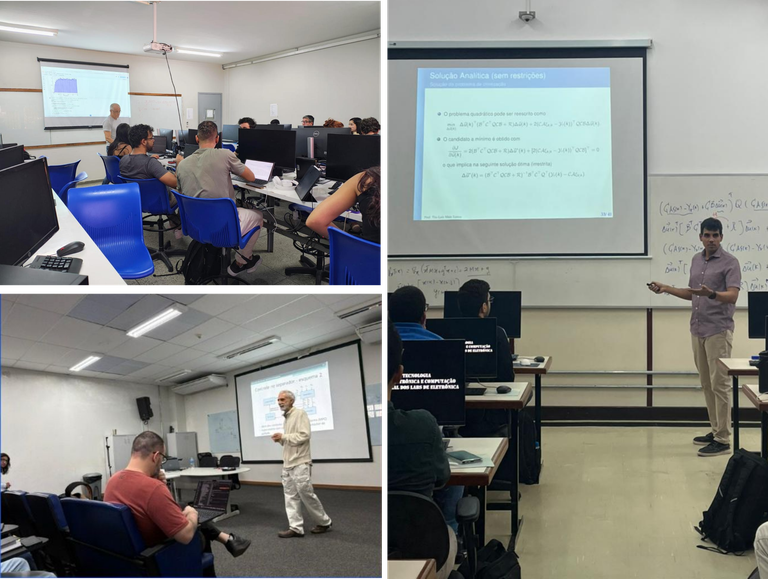
Figure 2: Montage of the three IFAC/SBA Seminar Series events, showing students and invited speakers during lectures and practical activities. The top-left image corresponds to the first event, held at UFRN in the Northeast region; the bottom-left image corresponds to the second event, held at UFMT in the Center-West region; and the right image corresponds to the third event, held at UFAM in the North region.