
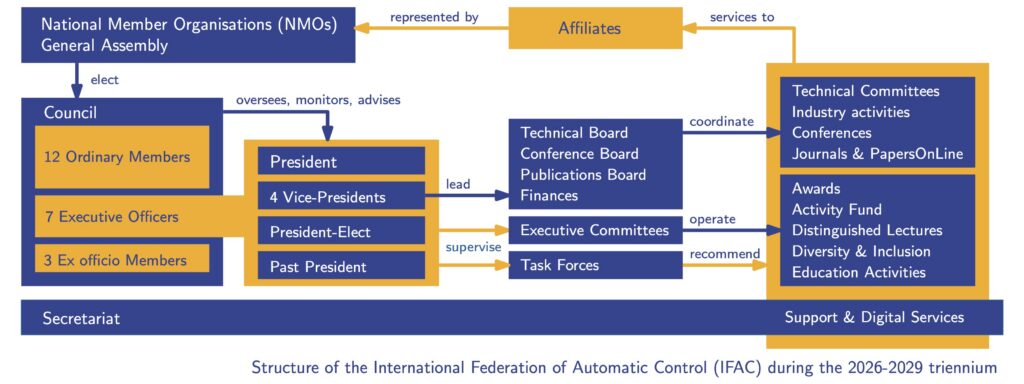
The General Assembly is the supreme body of the Federation and is comprised of the National Member Organizations (NMOs). NMOs are responsible for furthering the aims and objectives of IFAC within their respective countries. The General Assembly elects the Council. The Council is responsible for the management of the Federation to the General Assembly. The Council directs and supervises the functioning of the Federation. The Council consist of Executive Officers and Ordinary Members.
The President is the Chair of the Executive Officers and legally represents the Federation. The Executive Officers coordinate and supervise the technical and executive activities of IFAC, in particular those activities in the competence and carried on by the Technical Board, Conference Board, Publications Board and Executive Committees. A Secretariat composed of IFAC personnel assists and implements the decisions.
The complete list of IFAC Officials can be viewed on the IFAC Portal.
National Member Organizations
For each country/geographical area, one scientific or professional engineering organization, having a strong interest in automatic control and a sound professional background, or one council formed by two or more such organizations, shall be eligible for membership of IFAC. Such organizations, after admission to IFAC, will be known as National Member Organizations (NMOs) and shall have a responsibility for furthering the aims and objectives of IFAC within their respective countries.
Associated Member Organizations (AMOs)
IFAC Associated Member Organizations (AMOs) are a way for countries/regions who previously have not been able to be part of IFAC’s National Member Organizations (NMOs) due to financial limitations or other challenges, to participate fully in the IFAC community. AMOs should be comprised of well-defined groups of researchers, practitioners, other formally-recognized groups, active in the field of automatic control, from within a given country/region in which there is no NMO.
Benefits include mentorship and assistance from experienced IFAC officials, IFAC-specific information and invitations (such as official guest status for a representative appointed by the AMO to the IFAC General Assembly) participation in IFAC Technical Committees (TCs), and many others.
There is no yearly charge/membership fee for AMOs to pay, and only a small amount of triennial administrative tasks, both for IFAC and the AMO. As is expected of all IFAC NMOs and the individuals who participate in IFAC’s work and activities the AMOs must agree to adhere to the IFAC Code of Conduct. Individuals, members of the AMO, are also invited to register to the free of charge IFAC Affiliates program.
AMO applications should be submitted to the IFAC Secretariat, preferably after some initial contact with and guidance from the IFAC Membership Committee. From there the application will be forwarded for review and discussion by IFAC’s Membership Committee. The review from Membership Committee members will be transferred to the IFAC Executive Officers for a final decision.
Council
The Council is responsible to the General Assembly for the management of the Federation. It receives its mandate from the General Assembly and reports to it on the state of the Federation not less frequently than at each Triennial Congress.
Subject only to the directions of the General Assembly, the Council will formulate the policies of the Federation, in relation to the world community of control engineers, the National Member Organizations, intergovernmental and other non-governmental international professional organizations. It shall develop the long-term plans of the Federation for approval by the General Assembly and shall instruct the various boards and committees of IFAC accordingly.
The Council shall direct and supervise the functioning of the Federation, including both the technical and the executive activities. It will delegate particular functions to the appropriate boards and committees and will from time to time receive activity reports from those boards and committees.
All archived Council meeting minutes can be found here:
https://cloud.ifac-control.org/s/SSCQ9KMD3KmADQg
Advisors
Upon retirement from his/her IFAC office or any time thereafter, any IFAC official may be appointed by the President as an Advisor of IFAC. Such an appointment may be for life.
IFAC Advisors may be consulted by the active Executive Officers on any matter related to the Federation or given special assignments as the President deems appropriate.
Technical Board, Coordinating Committees and Industry Committee
The technical work of IFAC is performed by the Technical Board and the Coordinating Committees (CCs). Each CC consists of a number of Technical Committees (TCs). The Technical Committees (TCs) are responsible for the planning and monitoring of technical events, such as symposia, conferences and workshops, with the NMOs acting as hosts. They also promote their respective areas in other ways, such as establishing contacts with international organizations, publishing reports on selected topics, etc. The TCs cover specialized topics in control engineering. Their tasks among many others include promoting interest in emerging control subfields, assuming responsibility for technical meetings (or for series of such), providing for cooperation among specialists of their particular field, etc.
Starting from the 2017 World Congress in Toulouse (France) IFAC has established an Industry Committee with the goals to:
- Strengthen the engagement of industry and industry representatives in IFAC activities
- Enhance the value of IFAC to industry
- Help control research realize its full potential for industry impact
The tasks of the CCs and TCs include promoting interest in emerging control subfields, assuming responsibility for technical meetings (or for series of such), providing for cooperation among specialists of their particular field, establishing contacts with other international organizations, publication of reports on selected topics, etc. The CCs, the list of technical areas, the number of the respective TC and the Chair of the committee responsible for the activities are shown in the IFAC Affiliates Portal. The news and event details relevant to a TC can be found here.
Conference Board
The main duty of the Conference Board will be to consider symposia, conferences, workshops and other technical meetings as may be recommended to it by the Technical Committees and if it sees fit, arrange for their regulation and organization. It shall monitor technical meetings and advise their organizers.
In addition, the Conference Board will advise the Council on all matters regarding technical meetings. It shall from time to time review the technical meetings of IFAC in the light of its aims and objectives and shall report to the Council each year.
Publication Board
The Publications Board shall regulate and control all IFAC publications in accordance with guidelines laid down by the Council and will authorize expenditure on publications within strict budgetary limits approved by the Council.
Executive Committees
The Executive Committees of IFAC are
- The Awards Committee
- The Awards Committee shall regulate and control all award-related activities. It shall report to the IFAC President, who will present the Awards Committee’s work to the Council each year.
- The Membership Committee
- The Membership Committee shall normally take care of the relationship to NMOs and consider all applications for IFAC membership and make recommendations to the Council. It shall also advise the Executive Officers and Council on matters concerning IFAC affiliate members.
- The Activity Fund Committee
- The Activity Fund Committee shall normally take care of the IFAC Activity Fund, the call of proposals, their evaluation and selection. It shall report to the Executive Officers for final approval.
- The Distinguished Lecturer Program Committee
- The Distinguished Lecturer Program Committee shall normally take care of the Pawel J. Nowacki Distinguished Lecturer Program. Its tasks include the lecturer selection, the evaluation and the handling of the financial support of a lecture. It shall report to the Executive Officers.
- The Diversity and Inclusion Committee
- The Diversity and Inclusion Committee shall raise awareness for diversity, it shall monitor different aspects of diversity within IFAC and consult the Executive Officers and Council on all matters related to Diversity and Inclusion.
- The Education Activities Committee
- The Education Activities Committee shall facilitate educational and outreach activities at IFAC Conferences, across the IFAC Technical Committees, and other IFAC activities.
